
The traction converter as a key factor in e-mobility
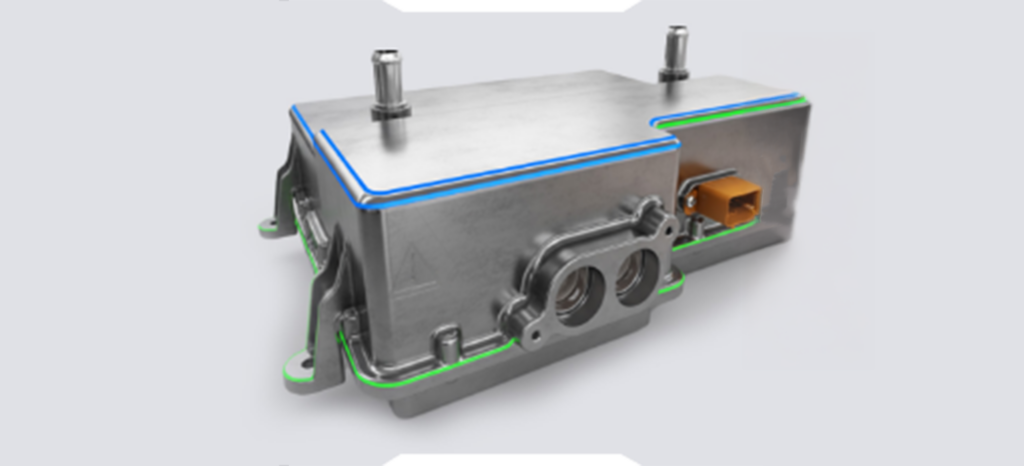
E-mobility is undergoing a profound technological leap: greater ranges, improved efficiency, and more compact drive systems are increasingly becoming the focus of vehicle development. At the heart of this development is the traction converter. It determines how efficiently electrical energy from the battery is converted into mechanical power, how high the power density of the drive is, and how robust the overall system is under real driving conditions.
Modern semiconductor technologies such as silicon carbide (SiC) and gallium nitride (GaN) are playing an increasingly important role in this context. However, the decisive factor for success is not only the material used, but also the system-oriented design of the entire traction inverter. SiC and GaN are key enablers in this context, embedded in an overall concept that combines efficiency, reliability, and series production readiness.
1. The right technologies for the right voltage ranges
SiC: The first choice for high-voltage inverters
Silicon carbide really shows its strengths in 800 V traction inverters. High reverse voltage resistance, temperature robustness, and low switching losses lead to greater efficiency and lower cooling requirements.
GaN: When high switching frequencies are required
Gallium nitride is ideal for applications below 650 V, such as DC/DC converters or on-board chargers. Extreme switching speeds reduce installation space and enable ultra-compact designs.
Note: The technology decision is based on voltage level, topology, and desired switching frequency – not on the material name.
2. Gate drivers – the invisible backbone of modern inverters
What gate drivers for SiC and GaN really need
High CMTI to absorb fast dv/dt transitions.
Miller clamp to prevent unwanted switching pulses.
Individually customized gate resistors, depending on EMC, thermal, and switching speed.
A cleanly designed gate driver is crucial for efficient, stable, and safe operation.
3. Layout optimization: the game changer for switching behavior and efficiency
Reduce power loop, maximize performance
Low parasitic inductance determines switching quality and reliability:
Target value: < 5 nH total inductance.
Methods: Vertically parallel currents, separate sense lines, busbars/laminates from >300 A.
A well-thought-out layout is what really makes expensive high-end semiconductors usable.
4. Thermal design: how components remain permanently efficient
Measures that make a difference in practice:
Double-side cooling reduces thermal resistance by up to 30%.
Directly connected copper layers reduce hotspots, especially with GaN.
Thermal management is not a separate issue – it determines real performance.
5. Simulations – faster to series production
Which models really offer added value:
Electrothermally coupled models provide realistic loss profiles.
Driving cycle simulations (WLTP, ECE) show real thermal loads.
Parasitics extraction enables precise predictions of dv/dt and overshoots.
Simulation not only saves time, but also prevents undesirable developments.
6. Modular architectures – the basis for scalable e-mobility systems
Why modular designs are the future:
SiC IPM modules reduce integration effort and offer reliable performance.
Combinations of GaN & SiC offer advantages when voltage and frequency ranges cover a wide spectrum.
Modularity accelerates development and ensures reproducible quality.
Conclusion: Holistic thinking leads to better inverters
For modern traction inverters in e-mobility, it is more important than ever that material selection, layout, thermal management, and simulation are considered in conjunction so that developers can exploit the full efficiency and reliability potential of modern wide bandgap systems. This article is therefore deliberately aimed at developers, system architects, and technical decision-makers in the electronics and automotive sectors—and is intended to provide them with practical, understandable guidance.